Designing a custom audience builder for precise targeting
Building a self-serve experience from scratch was both challenging and rewarding,
providing the freedom to explore, experiment, and innovate.

Summary
At Media.net, I co-designed a custom Audience Builder, taking the experience from concept to execution. Starting with a blank canvas allowed us to explore innovative solutions, while the Select Design System helped accelerate design decisions and maintain consistency throughout the product.
Duration
May - Sept 2025
Role
Product Designer
Tools
Figma, Figma Make
Team
Select
Role & Responsibilities
I collaborated with another Product Designer and two Senior Product Managers to drive the project from discovery through delivery. My role was to:
Research market & analyse competitors
User test & discover user insights
Brainstorm with the product managers and developers.
Wireframe & validate
High-Fidelity Design, define design tokens & comply with accessibility standards
Select Curation Platform
Business Model
Advertisers rely on agencies to reach the right audiences, and agencies need strong insights for better ROI. Curators play a key role by creating targeted inventory packages tailored to campaign needs.

Platform
Media.net’s curation platform helps curators create targeted deals, view impression insights, and manage inventory efficiently, enabling agencies to discover and buy quality publisher inventory.
Problems
Limited Targeting Precision
Curators could not combine or exclude audience segments, resulting in broader and less relevant audience targeting.
Operational Dependency
Curators depended on data providers for custom
audience creation, adding manual effort and slowing deal setup.
Missed Revenue Opportunities
Limited segmentation capabilities hindered premium deal and partnership opportunities.
Goal
The goal was to enable self-serve audience creation, reducing external dependencies, improving targeting precision, and enhancing the curator experience. Our North Star metric was to drive growth in deal revenue from custom-audience deals.
Design Research
I began by partnering with product managers to conduct a competitive analysis. We also leveraged insights from previous user interviews conducted for the Deal Creation workflow, which revealed key audience-building needs and pain points.
To deepen our understanding, we collaborated closely with stakeholders from the business and sales teams, gathering additional insights into customer requirements, market expectations, and existing challenges.

Key Issues
Curators often have a clear picture of the audience that they want to target but are struggling to create a precise audience targeting efficiently.
"I want to reach affluent consumers who are actively shopping for a luxury SUV, but not those who have recently purchased a vehicle."
- Audience Curator
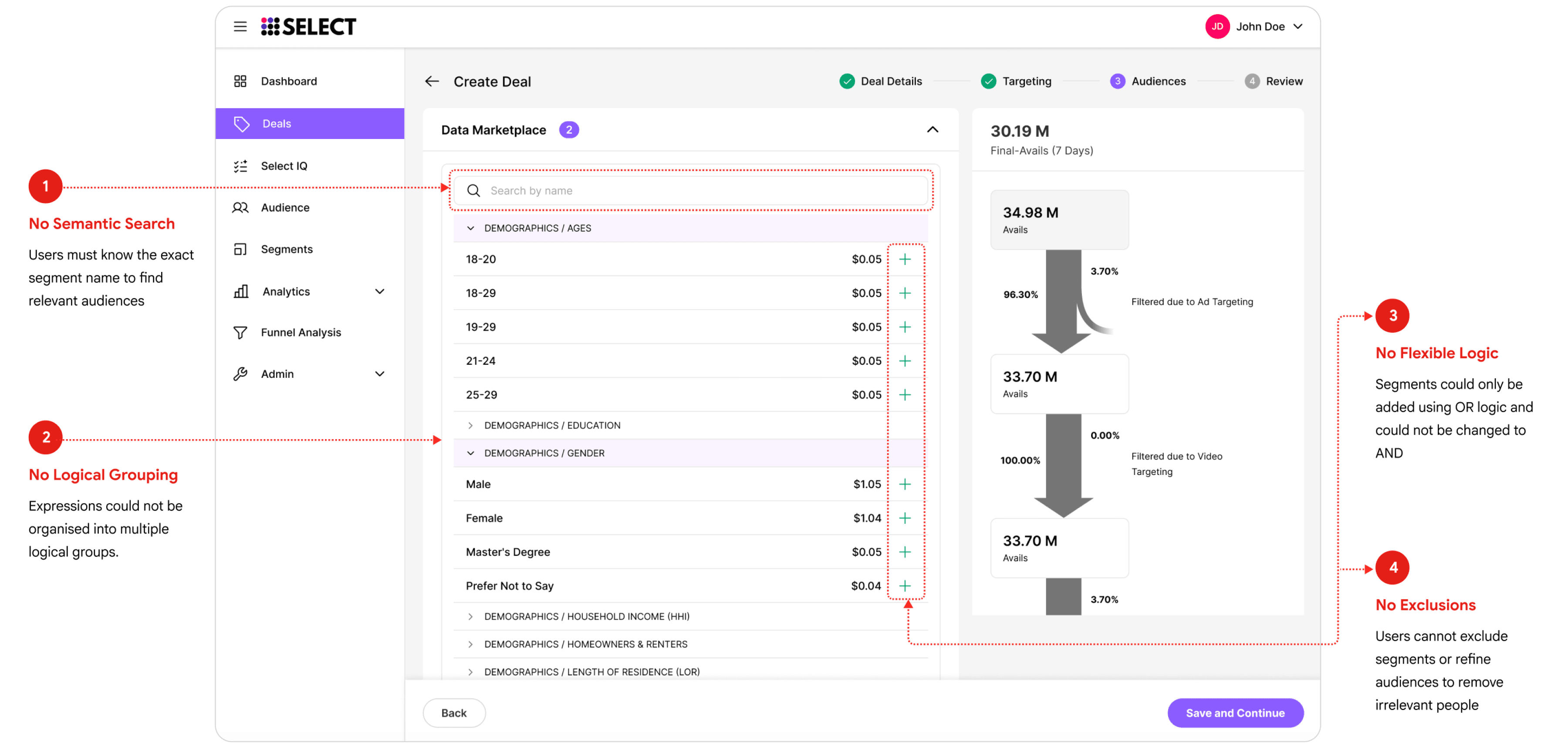
The current experience allows the users to select audience segments but lacks flexibility for precise audience targeting.
Design Explorations
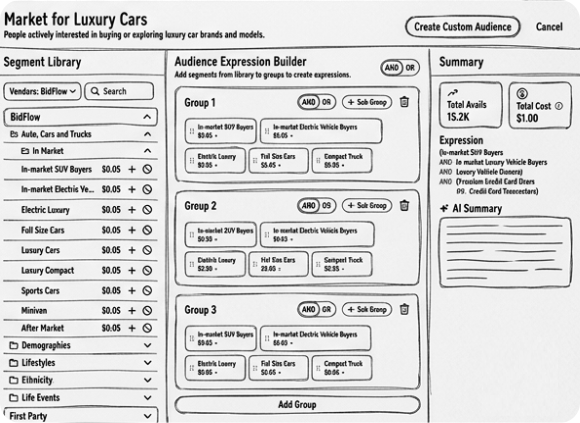
We explored multiple concepts through wireframes and rapid prototypes, using AI-powered tools like Lovable and Figma Make to quickly test ideas and gather stakeholder feedback.


Final Designs
After validating the direction through multiple iterations, we moved into high-fidelity design.
We ensured adherence to heuristic principles to create a usable and intuitive experience.
With a defined design system in place, it became easier to maintain consistency across the UI and streamline the overall flow.
Created an audience list screen for a clear overview and easy management of all audiences.
Designed a creation flow with groups, sub-groups, and segment-level operators; reduced effort using drag-and-drop with click support.
Used a full-page overlay for the creation flow to optimize limited screen space, enabling users to stay focused and complete audience creation without distractions.
Showed total cost and estimated impressions to improve transparency during audience building.
Added contextual info notes to guide users and reduce friction in the creation flow.
Included an AI summary to simplify complex audience expressions for better understanding.
Trade Offs
Power Features vs Learnability
Drag-and-drop segment building improved efficiency for experienced users but made the system less intuitive for new users. We balanced this by retaining click-based interactions as a fallback.
Screen Real Estate vs Context Awareness
A full-page overlay maximized focus and interaction space for creation, but reduced visibility of the broader product context. We prioritized task completion over navigation continuity.
Flexibility vs Simplicity
We enabled complex audience structures with groups, sub-groups, and nested logic. While this supported advanced use cases, it increased cognitive load. We mitigated this with progressive guidance like info notes and AI summaries.
Impact
40% growth in deal revenue
Deal revenue grew from $1.0M in Q2 to $1.4M in Q3, generating an additional $400K in revenue.
140% increase in deals creation
Deals created grew from 50 in Q2 to 120 in Q3, resulting in 70 additional deals.
166.7% increase in curator onboarding
Curator onboarding increased from 30 in Q2 to 80 in Q3, adding 50 new curators.
Takeaways
A design system made the entire process smoother and faster. Even a basic system can go a long way.
Exploring ideas beyond common design patterns can lead to better outcomes. With research and validation, unconventional solutions can sometimes prove to be the right ones.
Collaborating on edge cases strengthened my design thinking skills.
Simplifying components was one of the most rewarding parts of the project and reinforced the value of keeping things simple.
Feedback played a big role in improving the work. New perspectives often led to better solutions.
Learned that users prefer simple, intuitive experiences over unnecessary complexity.
Designed by me. © 2026 Pooja Puthran